

If you’re like me, whenever
I’m planning on getting some new gear, I go online and start doing my homework.
I read all the reviews and write-ups to get the pros and cons before I buy
anything. What helped me finally make a decision was a review by a photographer that I really admire, David Ziser. David is a
world class wedding photographer and has been speaking and teaching at seminars
for years. Plus he’s a Canon shooter himself, so when he said he was using one
of these lenses to shoot an entire wedding I took notice. I had read probably a
dozen write-ups on this lens, but when I read his blog post on this lens I was
sold. I’ve shot quite a few weddings
myself so I know what it requires to shoot a wedding and I was already a big
fan of his photography. On a full frame body the Tamron 28-300mm but on a crop
body (like my 40D) it’s a 43-465mm!
Pretty nice huh?
 The original shot of the warehouse was taken at ƒ6.3-55mm at ISO 160, the zoomed version was just cropped in Photoshop at 68%. Nice huh?

 |
This figurine was shot handheld at ƒ6.3-300mm - 1/100 at ISO 640. You’ll notice the shadows from a little fill
flash, but keep in mind this is almost straight out of the camera hand-held. Now I'm used to shooting
with Canon’s “L” glass and I knew I was going to have to make some compromises. Canon also makes a 28-300mm lens, but it is priced now at B & H for $2449.00, about $1800 more! The Canon weighs over 3½ lbs more than Tamron which weighs in at a little over a pound. Plus, all of my camera
bodies have a battery grip so weight was another factor. As far as the focal
range, the Canon lens was ƒ 3.5 – ƒ 5.6 and the Tamron was ƒ 3.5 – ƒ 6.3, which
meant I only lost a third of a stop with this lens.
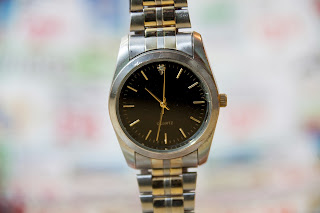 Another big factor was that
the Tamron was advertised as a Macro lens and said it could focus from only 1½ feet
away. I don’t know about you but that’s a big feature for me. I just had to test that out for myself. Check out the
photo of the watch. I grabbed a tape measure, and get this, the end of the lens was 9 inches away ( I focused
on the gem at 12 o’clock). The background I used was an insert from the Sunday paper from a local
grocery store and that was only 10 inches behind the watch! So this lens focused
from only 9 inches away and totally blew out the background only 10 inches away from it at ƒ6.3.
Another big factor was that
the Tamron was advertised as a Macro lens and said it could focus from only 1½ feet
away. I don’t know about you but that’s a big feature for me. I just had to test that out for myself. Check out the
photo of the watch. I grabbed a tape measure, and get this, the end of the lens was 9 inches away ( I focused
on the gem at 12 o’clock). The background I used was an insert from the Sunday paper from a local
grocery store and that was only 10 inches behind the watch! So this lens focused
from only 9 inches away and totally blew out the background only 10 inches away from it at ƒ6.3.
 Another big factor was that
the Tamron was advertised as a Macro lens and said it could focus from only 1½ feet
away. I don’t know about you but that’s a big feature for me. I just had to test that out for myself. Check out the
photo of the watch. I grabbed a tape measure, and get this, the end of the lens was 9 inches away ( I focused
on the gem at 12 o’clock). The background I used was an insert from the Sunday paper from a local
grocery store and that was only 10 inches behind the watch! So this lens focused
from only 9 inches away and totally blew out the background only 10 inches away from it at ƒ6.3.
Another big factor was that
the Tamron was advertised as a Macro lens and said it could focus from only 1½ feet
away. I don’t know about you but that’s a big feature for me. I just had to test that out for myself. Check out the
photo of the watch. I grabbed a tape measure, and get this, the end of the lens was 9 inches away ( I focused
on the gem at 12 o’clock). The background I used was an insert from the Sunday paper from a local
grocery store and that was only 10 inches behind the watch! So this lens focused
from only 9 inches away and totally blew out the background only 10 inches away from it at ƒ6.3.
Lastly, I was very impressed
with Tamrons VC (vibration control). I was used to shooting with Canons IS
(image stabilization) and you absolutely need this feature, especially with
these focal lengths. In his blog post, David shows images shot at 1/10 of a
second at 160mm. Most cameras these days can shoot quality photos at very high
ISO’s and with my Mk III I knew I could shoot all day at 2500 ISO or better but
sometimes you like to drag the shutter. So after seeing his images, I knew the
VC on this lens would work for me. Don’t get me wrong, I still love my trusty
“L” glass, but I’m not locked into that option these days. These days, my
Tamron 28-300mm VC is on my camera almost all the time I'm out shooting for myself.
Check out some of the photos taken with this lens online and I think you’ll be
impressed.
Like all this wasn’t enough, the price was the final clincher. The Canon lens sold for almost $2500 bucks and the Tamron 28-300mm Di VC lens was only $630 (when I originally wrote this post) but the price did go up to $849 with a bunch of improvements! So, when David Ziser said this was his new go-to lens for his wedding photography business, it was a no brainer for me. Sure the Tamron could be a little softer at certain focal lengths, but I knew I’d have no problem doing a little extra sharpening in post to save $1900 bucks and almost 3 lbs of weight. A lot of the reviews mentioned the Tamron had some chromatic aberration when zoomed all the way out to 300mm, but I use Adobe Camera RAW and fixing that was only a few mouse clicks away. In the Lens Corrections panel in CS6, just click the middle tab marked color and then click Remove Chromatic Distortion, how easy is that?
Like all this wasn’t enough, the price was the final clincher. The Canon lens sold for almost $2500 bucks and the Tamron 28-300mm Di VC lens was only $630 (when I originally wrote this post) but the price did go up to $849 with a bunch of improvements! So, when David Ziser said this was his new go-to lens for his wedding photography business, it was a no brainer for me. Sure the Tamron could be a little softer at certain focal lengths, but I knew I’d have no problem doing a little extra sharpening in post to save $1900 bucks and almost 3 lbs of weight. A lot of the reviews mentioned the Tamron had some chromatic aberration when zoomed all the way out to 300mm, but I use Adobe Camera RAW and fixing that was only a few mouse clicks away. In the Lens Corrections panel in CS6, just click the middle tab marked color and then click Remove Chromatic Distortion, how easy is that?
If you’ve been searching for a
good all-purpose lens for your Nikon or Canon camera that won’t break the bank,
maybe you should put the Tamron 28-300mm Di VC macro lens on your Christmas list
this year!
Remember, as always, keep
shooting and have some fun!


